Best Practices & Governance in Salesforce
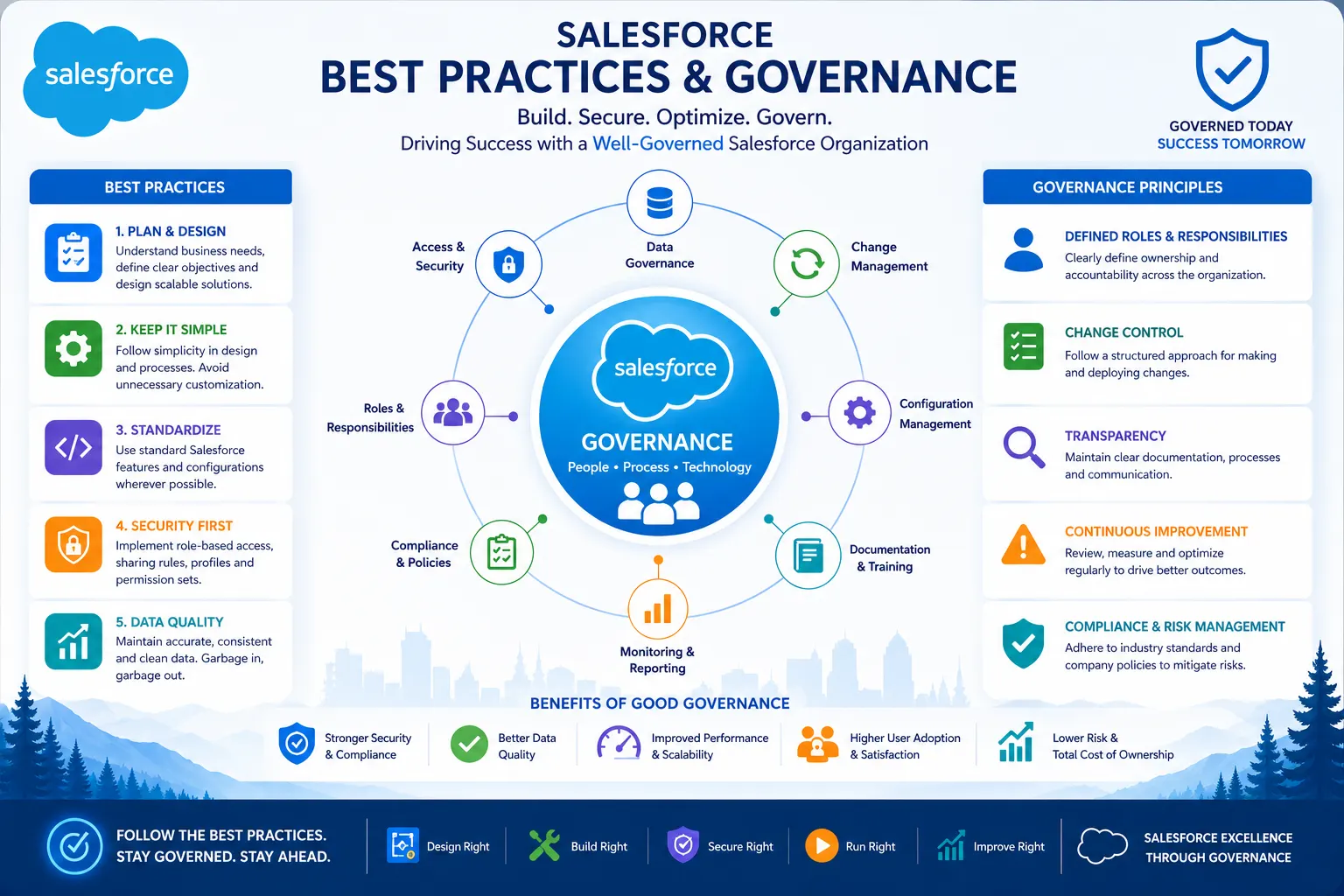
Salesforce Implementation Best Practices
Successful Salesforce implementation is not only about
configuring the CRM system, but also about following best practices that ensure
scalability, security, user adoption, and long-term business success.
Some important Salesforce implementation best practices
include:
- Understanding
business requirements clearly before development
- Keeping
the solution simple and scalable
- Using
standard Salesforce features whenever possible
- Maintaining
proper security and access control
- Following
coding standards and deployment processes
- Performing
proper testing before production release
- Providing
user training and documentation
These practices help organizations build a stable and
efficient CRM system that supports future business growth.
Business Benefit:
- Better
system performance
- Reduced
technical issues
- Improved
scalability
- Easier
maintenance and upgrades
CRM Adoption Strategies
CRM adoption refers to how effectively employees use
Salesforce in their daily work. Even the best CRM implementation can fail if
users are not comfortable using the system.
Organizations improve CRM adoption by:
- Providing
proper user training
- Creating
simple and user-friendly screens
- Automating
repetitive tasks
- Giving
role-based dashboards and reports
- Encouraging
users through management support
- Collecting
regular user feedback for improvements
Businesses also conduct workshops and demos to help
employees understand the value of Salesforce in their daily operations.
Business Benefit:
- Higher
employee productivity
- Better
data accuracy
- Increased
user engagement
- Improved
return on investment (ROI)
Data Governance
Data Governance is the process of maintaining accurate,
secure, and high-quality data within Salesforce.
Since CRM systems store important customer and business
information, organizations must ensure:
- Data
consistency
- Data
security
- Proper
data ownership
- Duplicate
prevention
- Data
validation and standardization
Salesforce provides features such as:
- Validation
Rules
- Duplicate
Rules
- Field-Level
Security
- Role
Hierarchy
- Sharing
Rules
- Audit
Tracking
These features help maintain clean and reliable data across
the organization.
Business Benefit:
- Improved
data quality
- Better
reporting accuracy
- Enhanced
security and compliance
- Reliable
business decision-making
Release Management
Release Management is the process of moving Salesforce
changes safely from development environments to production.
A proper release management process generally includes:
- Requirement
Gathering
- Development
in Sandbox
- Unit
Testing
- User
Acceptance Testing (UAT)
- Deployment
to Production
- Post-Deployment
Validation
Salesforce teams commonly use:
- Sandboxes
- Change
Sets
- DevOps
Center
- Version
Control Systems (Git)
Release management also includes maintaining rollback plans
and deployment documentation to reduce risks during production releases.
Business Benefit:
- Smooth
deployments
- Reduced
production issues
- Better
collaboration between teams
- Faster
delivery of business features
Conclusion
Following Salesforce best practices and governance
strategies helps organizations build a secure, scalable, and user-friendly CRM
platform. Proper CRM adoption, strong data governance, and structured release
management ensure long-term success and maximize the value of Salesforce
implementation.